
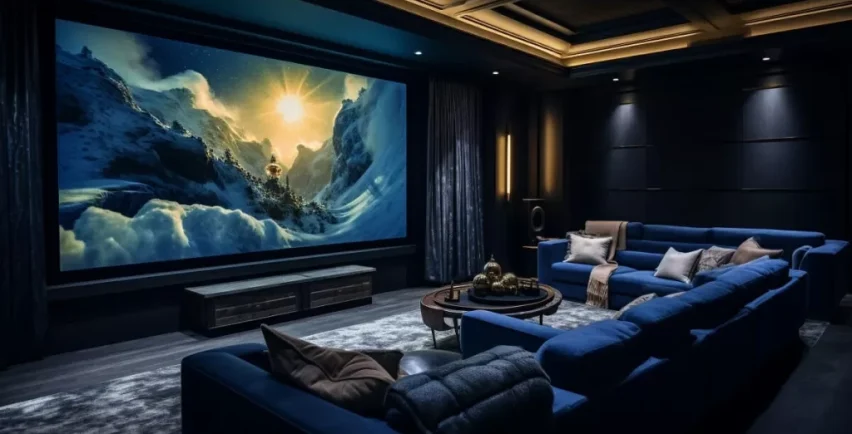
If you’re planning to build an area for movies the following question is more important than all other questions. Which size must the space be? Many believe that larger can be better but this isn’t always the case. A room that is too small can be uncomfortable and sound muffled and a room that is too big will need a lot of power to be filled with audio and video.
Finding the perfect spot based on your room’s dimensions is essential for getting the best cinema experience. This quick guide will help you understand different room sizes, shapes, and layouts before setting up your theater. For the best audio performance, professional sound system installation in Lahore can also ensure your speakers are positioned correctly and deliver clear, immersive sound throughout the room.
The Minimum Room Size for a True Cinema Experience
It is possible to set up a basic television with two speakers in nearly every space, however the real home cinema setup in Lahore will require a little more space. In order to accommodate a suitable projector screen and surround sound speaker system in a comfortable manner, your room must have the basic dimensions.
The smallest size recommended for a dedicated media space is approximately 10 feet wide and twelve feet in length. In meters, that’s about 3 meters wide by 3.6 metres long.
In a room this big it is possible to fit the 5.1 surround sound system. This means that you will have three speakers on the front of your room, 2 on the side, and a subwoofer on the floor. A tiny space like this is ideal for a comfortable family arrangement with a single row of seating that can accommodate three to four persons.
Why Medium and Large Rooms Offer Better Quality
In the event that you’ve got more room in the design of your home, upgrading to a larger or medium room will alter the layout of your home. A medium-sized room is usually about 12 feet wide and 18 feet in length. A room that is large can be upwards of 15 feet and 20 feet long, or bigger.
The larger rooms offer a variety of important advantages to your home cinema set-up in Lahore:
- Screen Size Choices: In a small space, a huge screen can cause eye strain because you’re too close to. A bigger space allows you to set up a 120 inch or 150-inch screen without any issues.
- Multiple rows of seating For those who want the real theatre feel with elevated seating, you’ll need a large room. Rooms with large spaces can accommodate three or more rows of recliners that are luxurious.
- Superior Speaker Position Surround sound speakers require space to spread out the sound waves. In a room that is large it is possible to upgrade to a 7.1 or Dolby Atmos system that will add speakers that are above your head to provide the ultimate 3D audio experience.
The Danger of Square Rooms and Perfect Cubes
When you look at your home’s design the form of the room is equal to the overall dimensions. The most unsuitable form for a sound space is a perfect square like one that’s fourteen feet in width and length.
If a room is square and has a perfect square shape, the sound waves that bounce off the right and left walls collide simultaneously as they bounce off the back and front walls. This causes a huge audio problem known as standing waves.
Standing waves can make some bass sounds feel high and booming, while a few notes may fade completely. A rectangular-shaped room is often the best option because it helps break up reflections naturally. This also makes it easier to incorporate Smart home automation in Lahore, allowing you to control your speakers, lighting, and other home theater features conveniently.
Calculating the Right Seating Distance
Your room’s size will determine the place you can put your furniture or seating. If you are near enough to your screen you’ll be able to see individual pixels on the screen, as you strain your neck to move it from left to right. If you’re at a distance, you will lose the cinema-like experience.
The most common rule is to multiply your screen’s size by 1.5 to determine the optimal viewing distance. For instance, if the projector screen measures 8 feet wide, then your sofa should be set approximately 12 feet from the screen’s surface.
Also, you must ensure that you leave 2 to 3 feet of space between your rear row of chairs. If your chairs are set to the side against the wall then your ears are far too near to the surround speakers which will cause the sound balance to be off.
Ceiling Height Matters for Sound and Video
It is common for people to overlook the ceiling’s height when designing a home theater in Lahore. The majority of residential rooms are built with a ceiling between 9 and 10 feet which is ideal.
If the ceiling in your home is too low, like under 8 feet, you’ll encounter problems with space. A big projector screen could be over the flooring. This means that the feet of people who are on the first row would interfere with the view of those behind them.
A low ceiling can also leave the ceiling with no room to install ceiling mounted Atmos speaker or concealed projector raises. A one that’s too tall, such as a double-height living space, creates an enormous echo chamber that will require expensive acoustic wall panels to fix.
Matching Your Audio Power to Your Room Volume
When you purchase audio equipment the amount of power is measured by watts. It is important to be sure to match the total power output of your amplifiers as well as speakers to the volume of air in your room.
A tiny 10×12 foot space just requires the standard receiver and tiny bookshelf speakers that can be extremely clear and loud. If you install massive tower speakers that are high-powered into an area that is small and the sound quality will swell and engulf the room.
However If you place an inexpensive soundbar in a big 15 by 20-foot media space it will sound thin, weak and empty. Professional home theatre services located in Lahore will be able to measure your room’s size and suggest the precise amount of power needed to fully fill the room.
Conclusion
The ideal size of a room depends completely on your budget as well as the available space in your home and the number of people you’d like to host simultaneously. A smaller rectangular space is ideal for intimate family dinners and a larger rectangular space is ideal for multi-row luxurious.
Avoid a perfectly square shape, make sure that your ceiling’s level is sufficient for screen layout, and also make sure your equipment’s power is in line with the size of the air. When you take your time choosing the right space and having experts help you with the design, you can create an impressive media space that will last for years.